
Fill out the Contact Form to get started!
Periodic classroom observations will be made to provide teachers with actionable information about their program implementation. This classroom support will vary based on the needs of the school and individual teachers.
Children at this grade level need repetition with the sounds of the letters and the consonant teams and vowel teams in order to develop automaticity. Utilizing brain friendly methods in whole group and small group instruction allows for this daily repetition until mastery is achieved.
Specific brain friendly techniques are utilized for younger learners to help them blend individual phonemes (sounds) into words. These techniques are multi-sensory and based on years of research and experience. Much of the kindergarten work is rooted in Montessori Methods with a careful attention to scaffolding reading skills.
Emphasis is placed on segmenting the sounds and writing what is heard. While this looks like spelling, it translates into improved reading ability while also improving spelling and writing. Randomized lists or high frequency word lists is counter productive to teach spelling because the child needs to experience a group of words with the same pattern (not necessarily words that rhyme which are often called word families) in order to internalize that pattern.
Older children frequently have gaps that need to be addressed in order for the child to move forward toward grade level reading. While the older struggling reader may read only a grade or two below level, he or she may be spelling much lower. Both issues can be helped when the child is able to learn the phonemes he or she is missing. Typically this part of the program requires simply 4-6 minutes per day in a whole group setting. After several months of daily instruction, most children will have gained automaticity with more than 100 distinct sound/symbol combinations. This is a key pillar of both the decoding and encoding process. Without this, students continue to struggle.
Targeted reading instruction (10 minutes minimum) enables older readers to develop their understanding of word patterns so the brain begins to recognize those patterns in future texts. Reading word lists that have a single distinct phoneme pattern enables students to identify those patterns. Utilizing brain friendly pre-reading techniques give the students opportunities to experience success and grow their confidence.
Children must read according to their individual skill level in order to develop their reading skills. Research has shown that 20-30 minutes/day is the minimum amount necessary. Utilizing decodable texts is helpful but not required in the majority of cases.
Daily spelling work (10 minutes minimum) with the current BFR word list being utilized by the classroom is necessary to reinforce the students’ retention of the word pattern. Gross motor and multi-sensory techniques are utilized to move the information from short-term to long-term memory. Evidence-based approaches for teaching spelling have the effect of positively impacting reading growth.
Older elementary children and teens who are reading below grade level have developed coping strategies to be successful and meet grade level expectations. Comprehension is often identified as the issue. Typically these children and teens have memorized many words. They struggle to easily and quickly decode unfamiliar words so they overly use context clues to guess the words being read. Preoccupation with reading the words correctly means they often cannot remember details from the text.
They benefit from systematic and direct instruction in the following:
Daily instruction in letter/sound combinations and practice in breaking words apart into their individual sounds assists with both reading and spelling. This work takes just minutes a day but, when done regularly, results in improvements in reading and spelling.
Regular targeted reading instruction (10 minutes minimum) enables older readers to train their brains to recognize word patterns so that the brain will recognize those patterns in future texts. Reading word lists that have a single distinct phoneme pattern enables students to identify those patterns. Older children and teens need word lists that contain unfamiliar words so the brain is forced to decode rather than rely on memorized words.
Children and teens must read according to their individual skill level in order to further develop their reading skills. Research has shown that 20-30 minutes/day is the minimum amount necessary. Utilizing decodable texts can be helpful with teens who are very beginning readers, but that is not required in the majority of cases with teens who are stuck at a 3rd grade reading level.
Teens have typically memorized a certain number of words but often have patterns of misspellings that get repeated or they may spell the same word three different ways on the same page. When asked to write a paragraph, they choose simple sentence structures and words with which they are very familiar to avoid spelling errors. Teaching them how to break words apart into syllables and then syllables into individual sounds is a key component to dramatically improving their spelling.
Studying roots, prefixes, and suffixes boost reading and spelling skills of older children and teens by training their brain to see the patterns that are in words beyond syllable types. For instance, when studying a root- its meaning, how to read and spell it, and many words using the root- that word part is moved into long-term memory. As a result, reading, spelling, and writing are improved while enhancing vocabulary. All of that impacts comprehension.
When a school contracts for three half-day PDs, WSR will provide up to 12 hours of classroom coaching and demonstration lessons at no additional cost.
A BFR trainer will be happy to consult with you at no charge to discuss program offerings and customize them to meet your school’s needs.
for up to 50 trainees
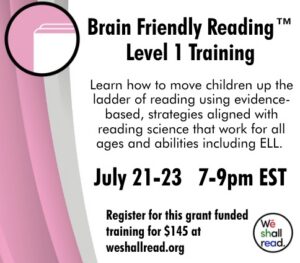
Learn how to start using BFR in this 6 hour hybrid, evening course for busy educators and parents!
Kristin will take you through all of the key elements and provide videos to watch at your leisure + weekly, live coaching where you can get support as you begin implementing the program.
Register at weshallread.org for $145 and receive print and digital copies of the 3rd edition of the Brain Friendly Reading Training Companion Guide.
Are you looking for ways to help children move up the ladder of reading? Expand your toolkit and get questions answered during our weekly Monday night group coaching calls that are free and open to everyone. Mondays 7-8pm EST bit.ly/WSRMondayNight